


Why Your Muscles Keep Getting Tight
Most reasonable people think that tight muscles are a problem. Your neck feels stiff, so you stretch it. Your shoulders ache, so you book a massage. Your hamstrings feel tight, so you spend more time trying to loosen them.
Flexibility can be trained. These treatments often help, sometimes dramatically. But if the same muscles keep tightening again, it is worth asking a different question.
What if your muscles are tight because your body still needs them to be?
The Body Is Always Trying to Stay Upright
When your skeleton supports your weight efficiently, your muscles can stay relatively relaxed while guiding movement. When it doesn’t, muscles have to work harder. They begin straining and stabilizing to stop the body from collapsing altogether.
This extra effort is called compensatory tension. It is not necessarily a sign that the muscle is damaged, only that the muscle is doing extra work.
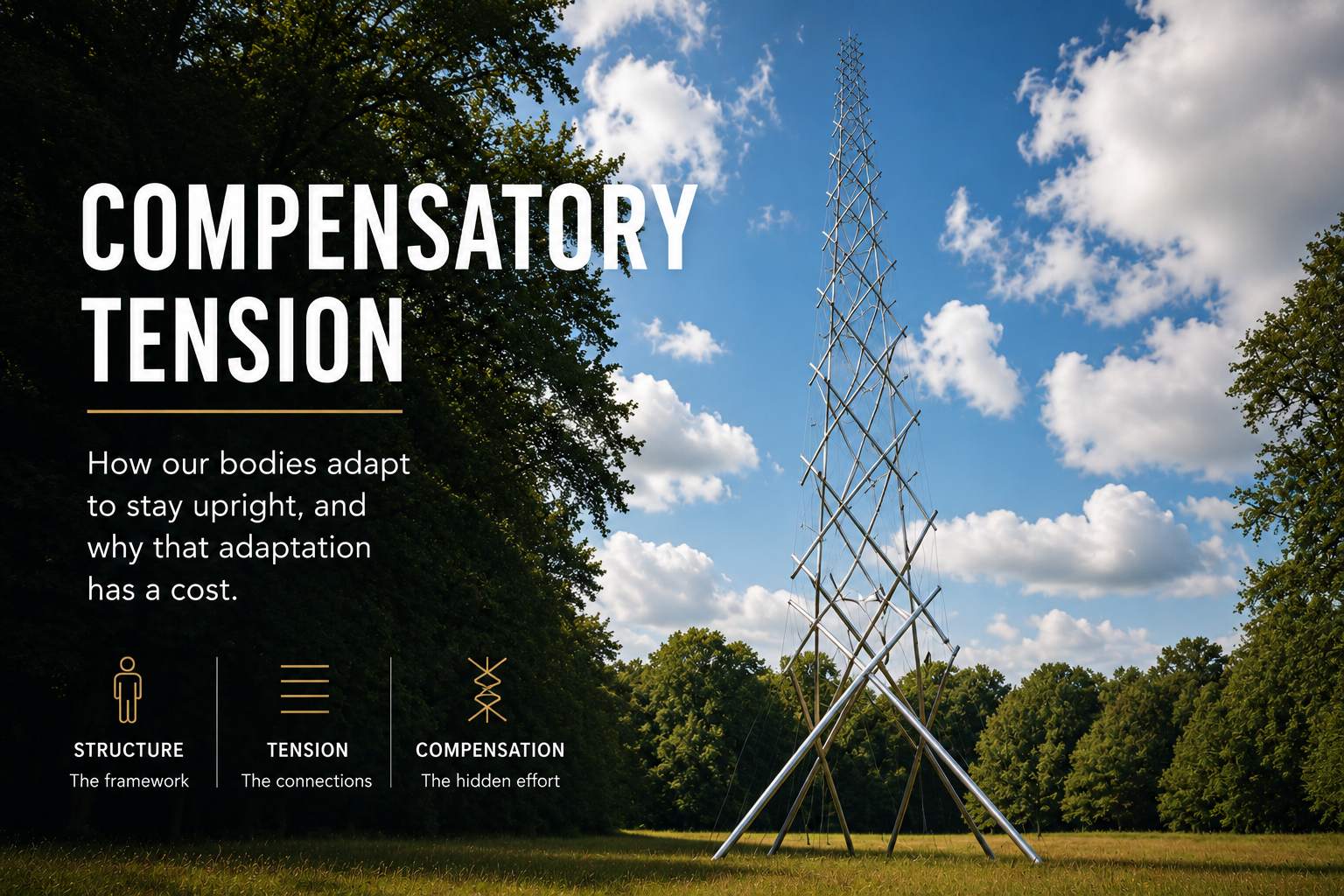
One of the best ways to understand compensatory tension is with a tensegrity model, like the Needle Tower at the Kröller-Müller Museum, depicted above. The rods never touch each other directly. The cables distribute forces throughout the entire structure.
Push on one part of the tower and something interesting happens. The tension doesn’t change only where you applied the force. It changes throughout the whole system.
While far more complex, the human body behaves in a similar way. Bones provide the body’s framework, while muscles, tendons, ligaments and connective tissues create a continuous network that helps stabilise and control movement.
When one region begins carrying weight inefficiently, other areas increase their tension to compensate.
Why Your Problem Isn’t Always the Problem
Stand up and start leaning forward. Carefully!
The bottom of your feet immediately have more work to do. Your calves tense. Your lower back stiffens, but the tightness obviously isn’t the problem. It is responding to the demand for stability.
The same thing happens throughout the body. A hanging head forces the jaw to tighten to stay closed. Tight hamstrings help to control the pelvis. Stiff muscles provide support that the skeleton is no longer supplying efficiently.
The place that hurts is not always the place doing something wrong. Often it is simply overburdened. Which is…
Why Stretching Doesn’t Last
Stretching, massage and heat can all make a muscle feel better. There is nothing wrong with that.
But if the body still needs that muscle to provide extra support, the tension returns. This is why many people feel wonderfully loose after a massage, only to wake up stiff again, or worse, the next morning.
The muscle relaxed. The mechanical demand did not.
Reduce the Need, Reduce the Tension
Your body cannot simply switch off muscles that it still depends on. The most effective long-term strategy is to reduce the need for compensation in the first place. As the skeleton supports more bodyweight, muscles no longer need to work as hard just to keep you upright.
This is one of the reasons posture matters so much, and it helps us to understand what good posture actually is. Good posture is not about standing unnaturally straight or forcing your shoulders back. It is about allowing your body to rest on its skeleton instead of asking muscles to do work that bones were designed to do.
The next time a muscle feels tight, resist the urge to ask: “How do I make this muscle relax?”
Instead, ask: “Why is this muscle working so hard?”
That simple change in perspective leads to a better understanding. A tight muscle is often the temporary solution your body has found to a larger mechanical challenge.